

Low water pressure is easier to fix when you know what is actually causing it. A weak shower, slow faucet, or underperforming appliance can come from several different problems, and the right solution depends on whether the issue starts at one fixture or affects the whole house. The cause is something straightforward, such as a clogged aerator, a partly closed shut-off valve, mineral buildup, or a fixture-specific blockage in many homes. In other cases, low pressure points to a broader plumbing issue, such as a failing pressure-reducing valve, a hidden leak, aging pipes, or a municipal supply problem.
A reading below 40 PSI is generally considered low, while many homes generally operate between 45 and 80 PSI. Residential water-pressure guidance
This guide explains the most common causes of low water pressure in a house, how to tell the difference between whole-house and fixture-specific problems, and which practical fixes are safe to try first. It also covers the warning signs that mean it is time to call a plumber for low water pressure, especially when the problem involves leaks, damaged valves, corroded pipes, or pressure loss that affects the entire home.
Why Is the Water Pressure Low in My House?
The reasons why water pressure is low in your house are listed below.
- Low municipal water pressure: Reduced pressure from the local water supply can affect multiple fixtures throughout the house, particularly during periods of high demand.
- Partially closed main shut-off valve: A valve that is not fully open can restrict water entering the home and reduce flow at several fixtures.
- Failing pressure-reducing valve (PRV): A damaged or malfunctioning PRV can cause low, unstable, or inconsistent water pressure throughout the plumbing system.
- Water main or service-line leak: A leak in the incoming water line can reduce available pressure while causing unexplained water loss or damp areas around the property.
- Corroded or aging pipes: Internal corrosion and mineral deposits can narrow older pipes and gradually restrict the amount of water reaching fixtures.
- Mineral or debris buildup: Scale and debris can restrict flow through supply lines, faucet cartridges, showerheads, aerators, and other plumbing components.
- Clogged faucet aerator or showerhead: When weak pressure affects only one faucet or shower, a blocked outlet is often the likely cause.
- Hot-water system restriction: If only hot water has low pressure, the restriction may involve the water heater, mixing valve, hot-water piping, or another hot-side component.
- Private well system problems: Homes supplied by a well may experience low pressure because of issues with the pressure tank, pressure switch, pump, or well supply.
- Undersized or restricted supply lines: Supply lines that cannot provide enough flow for the home’s demand can cause weak pressure, especially when several fixtures operate simultaneously.
How Can You Fix Low Water Pressure in a House?
To fix low water pressure in a house, follow the steps below.
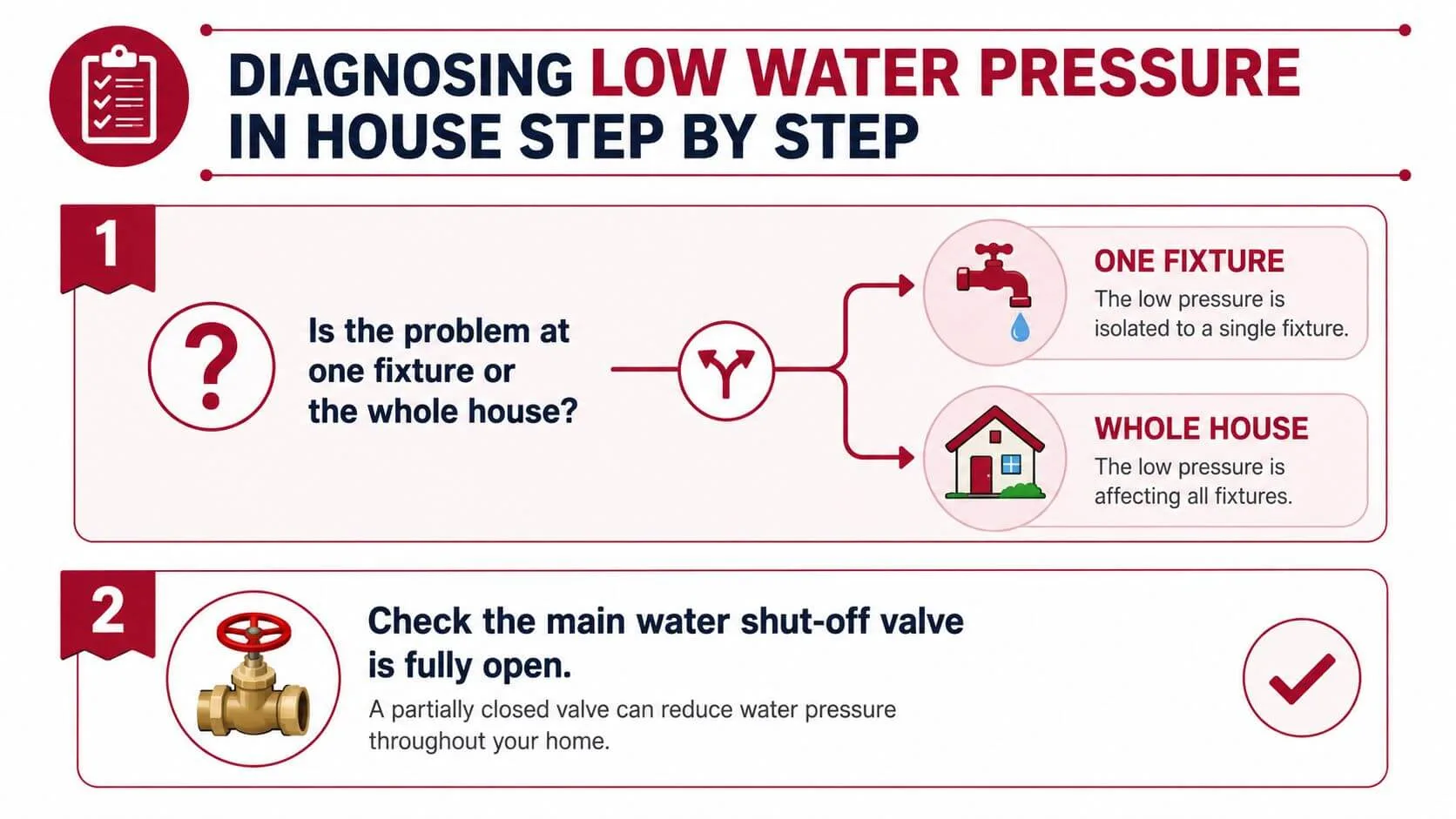
- Test several fixtures to see whether the problem is isolated or house-wide.
- Check hot and cold separately to identify whether the issue is tied to the water heater side.
- Confirm the main shut-off valve is fully open near the meter or where the water line enters the home.
- Inspect the PRV for corrosion, wetness, or signs of failure.
- Measure static pressure with a gauge at an outdoor spigot or laundry faucet.
- Clean fixture aerators or showerheads if the problem is limited to one outlet.
- Investigate for leaks, mineral buildup, or aging pipe restrictions if the problem is broader.
- Call a licensed plumber when the issue involves buried lines, regulator replacement, severe corrosion, or unexplained pressure loss.
A basic plumbing inspection becomes useful when these checks reveal a damaged valve, unexplained dampness, or a problem affecting several branches. See this plumbing inspection guide for next steps.
Is Low Water Pressure a Plumbing Emergency?
No, low water pressure is not always a plumbing emergency, but it can become urgent when it starts suddenly, affects the whole house, or points to an active leak or failing plumbing component.
Low pressure needs prompt attention when there is a sudden drop in pressure throughout the house, both hot and cold water are weak at every fixture, or you hear water running when no fixtures are on. Additionally, if the yard near the meter or service line is wet, walls, floors, or the foundation shows dampness, the PRV is leaking, corroded, or no longer controlling pressure, or a water heater relief valve discharges repeatedly, it is crucial to address the issue immediately.
A slow faucet at one sink is usually not an emergency. A sudden whole-house pressure loss is different. That pattern can indicate a supply leak, a failed pressure regulator, a damaged shut-off valve, or a municipal issue that needs fast diagnosis.
When warning signs suggest a leak or system failure, stop basic troubleshooting and arrange 24 Hour Emergency Plumbing Services as soon as possible.
What Is Considered Normal Water Pressure for a House?
Normal residential water pressure is typically 45 to 80 PSI, with many homes performing well around 45 to 60 PSI. Readings below 40 PSI are commonly considered low, and pressure above 80 PSI is generally too high for a residential plumbing system. EPA WaterSense pressure-testing guidance
Pressure that is too low can cause weak showers, slow faucets, poor appliance performance, and reduced flow at multiple fixtures. Pressure that is too high can strain pipes, valves, water heaters, and appliances, which may increase wear and raise the risk of leaks or component failure.
A normal reading should also stay reasonably stable during everyday water use. If static pressure looks normal but drops sharply when another fixture runs, the problem may still involve a restriction, a failing PRV, or a supply issue.
How Do You Test Your Home’s Water Pressure Yourself?
To test your home’s water pressure, follow the steps below.
- Turn off all water use. Stop faucets, showers, toilets that are refilling, washing machines, dishwashers, irrigation, and ice makers.
- Check that the main shut-off valve is fully open. A partly closed valve can affect the reading.
- Attach the gauge to an outdoor spigot or laundry faucet. Tighten it by hand.
- Open the spigot fully. Wait for the needle to stop moving.
- Read the PSI. Normal residential pressure is usually 45 to 80 PSI. Below 40 PSI is commonly considered low. Above 80 PSI is generally too high.
- Run one more fixture and watch the gauge. A sharp drop during use can point to a restriction, a failing PRV, or a leak.
The problem may be inside the plumbing system if static pressure is normal but dynamic pressure drops fast. For a visual explanation of how the property supply connects to household fixtures, review our home water supply system guide.
Why Did My Water Pressure Suddenly Drop Throughout the House?
A sudden, whole-house pressure drop usually points to a supply-side issue rather than a clogged faucet. Common explanations include a partially closed main shut-off, a failing PRV, a supply leak, a municipal issue, or a sudden failure in older restrictive piping. If every faucet and shower became weak at about the same time, focus on the incoming water controls before taking apart fixtures.
This kind of sudden change matters because it helps separate a long-term restriction from an active problem. Gradual decline often matches corrosion or buildup. Abrupt decline suggests valve movement, regulator failure, leak activity, or public supply disruption.
Could Municipal Supply Issues or Peak Usage Hours Be Causing Low Water Pressure?
Yes, if nearby homes also have weak flow, the issue may be outside your property. Public water guidance notes that high demand, dry-weather outdoor use, inadequate pumping, undersized mains, leakage, equipment failures, and blocked service pipes can all affect pressure across an area. Water-pressure guidance from Ofwat
A quick neighbor check is often useful. If pressure is weak at your house but normal next door, the problem is likely on your property. If several homes are affected, contact the local water utility before assuming your pipes need repair.
Could a Closed Main Water Shut-Off Valve Be Restricting Water Flow?
Yes, a partially closed main shut-off valve can reduce flow throughout the house. This is one of the most common causes after recent plumbing work, meter work, renovations, or winterizing.
Find the main valve near the water meter or where the service line enters the house. A gate valve should be fully open. A ball-valve handle should be parallel with the pipe. If someone left it partly closed, opening it fully may restore normal flow immediately. If it sticks or looks damaged, review common water shutoff valve problems before forcing it.
Do not force a seized or corroded valve. A broken main shut-off creates a bigger repair than the original pressure complaint.
How Does a Faulty Pressure Reducing Valve (PRV) Affect Water Flow?
A pressure reducing valve, or PRV, regulates incoming water pressure to the house. When it begins to fail, pressure may become too low, unstable, or inconsistent from one moment to the next. You may notice weak flow at multiple fixtures, poor pressure recovery, or a gauge reading that does not respond properly when the valve is adjusted.
Look for a bell-shaped valve on the main line, commonly after the meter. Signs of trouble include corrosion, wetness, mineral crust, or a damaged adjustment stem. A leaking or badly corroded PRV should be replaced, not adjusted repeatedly.
Is a Water Main Leak Causing Your Low Water Pressure?
Yes, a water main leak can significantly reduce available pressure in your home while wasting a large amount of water, particularly if the leak occurs on the main service line before reaching branch fixtures.
Check exposed piping, the meter area, the foundation, and any soft or persistently wet ground outside. Continued meter movement supports the case for a hidden leak, even if the leak has not yet produced obvious indoor damage.
Why Is Water Pressure Low in Only One Faucet or Fixture?
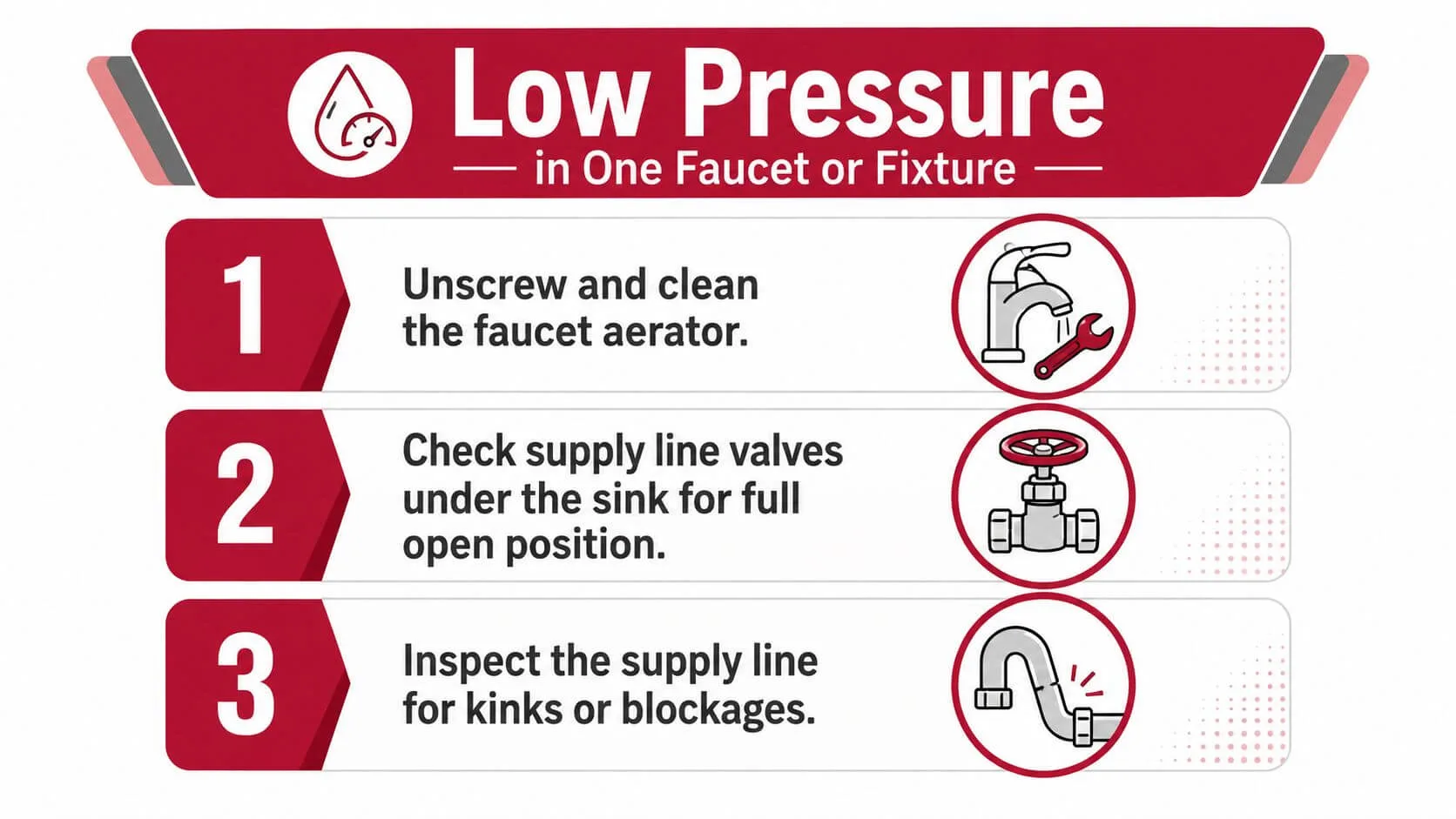
When low pressure affects only one faucet or one fixture, the restriction is usually local. Common causes include a clogged aerator, a worn faucet cartridge, a partly closed fixture stop, a kinked supply line, mineral buildup in the outlet, or debris trapped after plumbing work.
Start with the outlet itself. Unscrew the aerator, keep the screen and washer together, rinse away grit, and soak the parts in white vinegar if mineral scale is visible. Reinstall it and test again. If the faucet is still weak with the aerator removed, inspect the cartridge, fixture stops, and short supply line.
Practical rule: Remove the outlet restriction before touching the main water system.
Showers follow the same logic. Remove the showerhead, inspect the spray openings for scale, and briefly flush the shower arm with the head removed. Strong flow from the arm but weak flow through the head confirms that the showerhead is the restriction.
Why Is Low Water Pressure Only Affecting Hot Water?
Hot-water-only pressure loss usually points to the water heater side of the system. The restriction may involve the heater inlet valve, hot outlet, sediment inside a tank heater, a blocked inlet strainer on a tankless unit, a mixing valve, or an anti-scald cartridge.
Before servicing the heater, shut off its gas or electrical power and let it cool. Drain only what your equipment and installation safely allow. If the manufacturer provides a sediment-removal procedure, follow those instructions closely. A water-heater-side diagnosis is a good reason to arrange water heater repair services, especially when the hot-side restriction affects several fixtures.
Can Corroded or Old Plumbing Pipes Cause Low Water Pressure?
Yes, corroded, galvanized, or aging pipes can narrow internally as rust and mineral deposits reduce the open passageway. This usually causes a gradual decline rather than a sudden drop, and the effect is often seen across multiple fixtures or branches.
Cleaning an aerator will not solve a restricted main or branch line. Homes showing this pattern often need a licensed evaluation and possibly an old plumbing pipe evaluation before anyone recommends descaling, repair, or repiping.
How Do You Fix Low Water Pressure Caused by Aerator Clogs?
To fix low pressure caused by aerator clogs, follow the steps below.
- Unscrew the aerator from the tip of the faucet spout.
- Disassemble the parts, carefully separating the screen, washer, and housing.
- Rinse away loose debris under running water.
- Soak in white vinegar if mineral scale or buildup is present.
- Scrub gently with a soft brush to remove stubborn deposits, then rinse thoroughly.
- Reinstall or replace: Reassemble and screw the aerator back on. If the screen is damaged or remains clogged, replace it with a new aerator.
How Can You Adjust Your Home’s Water Pressure Regulator?
To adjust your home’s water pressure regulator, follow the steps below.
- Measure the water pressure first: Check the pressure with a gauge before making any adjustments. The regulator controls incoming pressure for the whole house, so raising it blindly can stress fixtures, appliances, and piping. Many plumbing codes require regulation when incoming pressure exceeds 80 PSI, which is why measurement should come first. Residential pressure-regulator guidance
- Locate the valve components: Find the adjustment screw and locknut on the PRV.
- Adjust in small increments: Loosen the locknut, make a small adjustment, retighten it, and recheck the gauge. Work in small increments only.
- Evaluate the response: If the reading does not respond, or if the valve is leaking or heavily corroded, replacement is usually the correct fix.
How Do You Clear Mineral Deposit Buildup in Supply Lines?
Mineral buildup can affect faucet outlets, showerheads, cartridges, branch supplies, and, in some homes, the piping itself. Cleaning with vinegar may be enough for removable fixture parts. A line can sometimes be isolated, disconnected, and flushed with clean water to remove loose debris for accessible supply lines.
Severe internal restriction is different. Rinsing a faucet will not restore a pipe that has narrowed substantially from scale. In those cases, the line may need descaling, repair, or replacement after the pipe condition is confirmed. Where hard water is contributing to repeated scale, water quality services can help identify the water condition before equipment is selected. For accessible restrictions, pipe descaling may be more appropriate than repeatedly replacing fixtures.
Can Installing a Water Pressure Booster Pump Fix the Problem?
Yes, a booster pump can help when incoming municipal pressure is consistently too low and the house does not have an internal restriction, a partly closed valve, a leak, or a failed PRV. It is not the first fix to try, because boosting pressure does not solve clogged fixtures, damaged valves, or corroded piping.
A booster pump makes the most sense after you confirm the incoming pressure is genuinely low and stable, the controls are working correctly, and the plumbing system is otherwise sound. If pressure is normal at the entry point but weak at certain fixtures, a booster pump is not the right solution.
When Should You Call a Licensed Plumber for Low Water Pressure?
Call a licensed plumber when the problem remains system-wide after you confirm the main valve is fully open and test the PRV. Professional help is also the right choice for hidden leaks, underground supply lines, damaged pipes, severe corrosion, regulator replacement, and suspected restrictions in old galvanized piping.
Do not attempt to cut into a pressurized main, replace a buried service line, or dismantle a corroded regulator without the right tools and code knowledge. Call promptly when you see wet ground near the meter or foundation, the meter moves with all fixtures off, or pressure drops suddenly without an obvious fixture cause. Use when to call a plumber as the decision point when basic checks no longer identify a safe, clear repair.
How Can You Prevent Low Water Pressure Issues in the Future?
The best prevention is to track your normal pressure and maintain the components that control flow. Test static pressure at an outdoor hose bib from time to time, exercise the main shut-off and fixture stops so mineral buildup does not seize them, and inspect visible pipes for corrosion or moisture.
Flush a tank water heater according to the manufacturer’s maintenance guidance to reduce sediment before it affects hot-water outlets. Homes on private wells should also include pressure-tank and pressure-switch checks in routine maintenance.
Watch for early warning signs such as a lower baseline reading than your normal pressure, sputtering or pulsing flow when a fixture opens, dampness around the meter, foundation, walls, or exposed piping, and an unexplained increase in the water bill.
Contact WhatsDemand to coordinate a licensed plumbing professional if your house still has weak flow after these checks. Describe which fixtures are affected, whether the problem involves hot or cold water, your static and running pressure readings, and what you found at the main valve and PRV. That information helps the matched plumber start with the right diagnosis instead of repeating basic guesswork.