

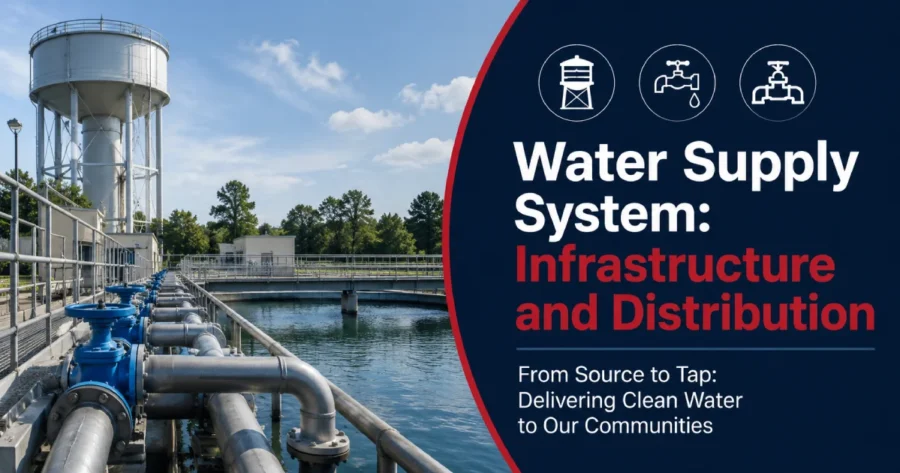
A water supply system is the network of infrastructure that collects, treats, stores, and delivers water to homes, businesses, farms, and communities in the USA. Water makes the journey from source to tap through a series of stages (drawn from rivers, lakes, or groundwater), then treated to remove contaminants, stored, and finally pushed through a distribution network under pressure until it reaches a home.
The specific setup varies depending on the available water source, local geography, population size, and the level of development of a region’s infrastructure. Over 148,000 public water systems currently operate, ranging from small rural wells serving a few residents to larger municipal networks.
What Is a Water System?
A water system is the network that brings water from its natural source to homes and businesses, and carries it away again after use. The system is built from the source of supply, the treatment of the water, and the distribution of that water to users.
A water supply system covers the entire journey from the source to the tap, while a water treatment system is the stage where raw water is clarified and disinfected to make it safe for use.
A water distribution network is the final phase, including the pipes, storage, and pumps that carry potable water from the treatment plant to consumers. The stages make up a water quality system, ensuring water stays safe from source to faucet.
What Is a Public Water System?
A public water system provides water to the public for human consumption through pipes or similar conveyances, qualifying once it has at least fifteen service connections or regularly serves an average of at least twenty-five people daily for at least 60 days a year, as defined under Title 40 CFR Section 141.2 of the federal Safe Drinking Water Act.
A public water system differs from a water supply (household well) because private wells are not regulated by EPA and are left to the homeowner to test and maintain. The regulatory role falls to the Texas Commission on Environmental Quality (TCEQ), which oversees water systems under Title 30 of the Texas Administrative Code, Chapter 290, which covers water quality, treatment, and operator standards.
What Is a Water Source?
A water source is a natural origin point, from surface water (lakes, rivers, and reservoirs) or groundwater) held underground, that supplies water to homes and communities. 170 million Americans in the U.S. get their tap water from surface sources like rivers and lakes, while close to 90 million rely mainly on groundwater pumped from underground.
How Does the Water System Work?
The water system works through sourcing raw water, treating it, and distributing it to users. Each stage processes it before the next, turning untreated water into safe-to-drink water. Below are the stages broken down in more detail, starting with how raw water is first drawn from its source.
1. Raw Water Extraction
Raw water extraction involves drawing untreated water from rivers and lakes into the system via an intake structure with gates and screens for surface sources, or well pumps for groundwater, after which low-lift pumps move the raw water into the treatment plant.
For example, the Brazos Regional Public Utility Agency draws its raw water from an intake on Lake Granbury, which is fed by the Brazos River, and any surface-sourced system in Texas falls under TCEQ’s 30 TAC Chapter 290, which requires pretreatment, including disinfection, coagulation, sedimentation, and filtration, before the water reaches consumers.
2. Centralized Water Treatment
Centralized Water Treatment works through coagulation, where chemicals bind dirt and small particles together, followed by flocculation, gently mixing the water to form larger, heavier flocs, then sedimentation, where the flocs settle to the bottom and are removed.
The clear water on top passes through filters made of sand, gravel, or charcoal to remove any remaining particles, and then disinfection kills any remaining pathogens. Chicago’s James Jardine Water Purification Plant, which treats raw Lake Michigan water using disinfection, coagulation, flocculation, and filtration. It purifies about 1.4 billion gallons of water per day for the city.
3. Storage and Pressure Regulation
Storage and pressure regulation are handled by tanks or ground-level reservoirs that hold treated water above the distribution system, using gravity to maintain steady pressure throughout the network. Pumps refill the tanks whenever water is used, while water in the top portion of an elevated tank feeds the system by gravity, with the rest held in reserve for firefighting.
Massachusetts guidelines require normal working pressure to be between 60 and 80 PSI, with devices required when static pressure exceeds 100 PSI.
How Does the Water Supply System Connect to the Overall Plumbing System?
The water supply system connects to the overall plumbing system through a service line that taps into the municipal water main and runs to a water meter, which measures flow before the water enters a property’s own piping. The water system for a home or property is connected to a city water main through a water lateral service line and a water meter, with the property owner responsible for everything downstream of the meter.
U.S. plumbing codes require pressure-regulating valves once supplied water pressure exceeds 80 PSI because municipal main pressure exceeds what indoor fixtures are built for, which is the exact point where the municipal plumbing system takes over to distribute water throughout the building.
Which Systems Are Used for Water Supply and Distribution Networks?
The systems used for water supply and distribution networks are grid (looped) and branch layouts. Grid systems interconnect pipes in loops, avoiding dead ends and keeping water flowing to every point even during repairs, while branch layouts run in one direction and create dead-end lines prone to taste and odor issues and bacterial buildup.
Modern design standards favor looping, and water pipelines are now required to be looped for bidirectional supply, with dead-end mains allowed only on a case-by-case basis.
What Are the Key Components of Water Infrastructure?
The key components of water infrastructure are listed below.
- Intake Structure: Draws raw water from rivers, lakes, or reservoirs through screens and gates that filter out large debris before pumping begins.
- Water Treatment Plant: Removes contaminants and pathogens from raw water through coagulation, sedimentation, filtration, and disinfection.
- Transmission Mains: Large-diameter pipelines carry treated water over long distances from the treatment plant to storage facilities or distribution zones.
- Pumping Stations: Motorized pumps lift water to higher elevations or maintain pressure in the network.
- Storage Reservoirs and Elevated Tanks: Hold treated water in reserve and use gravity to stabilize system pressure in peak demand.
- Distribution Mains: Smaller pipes branch off from transmission mains to deliver water directly into neighborhoods and streets.
- Service Lines: Connect individual buildings to the distribution main, carrying water onto private property.
- Water Meters: Measure the volume of water entering a property for billing and consumption monitoring.
- Valves: Isolate specific pipe sections in repairs or emergencies without shutting down the entire network.
- Fire Hydrants: Tap into distribution mains to supply pressurized water for firefighting and emergency response.
How Is Storage and Pressure Regulated?
Storage and pressure are regulated through elevated tanks positioned high enough that gravity pushes water down to customers at sufficient pressure, paired with pumps that refill storage as demand draws it down. The Texas Commission on Environmental Quality (TCEQ) requires storage capacity to be at least 80 feet above the highest service connection in its pressure plane, and utilities must maintain a minimum pressure of 35 PSI even in power outages. It balances demand, elevation, and storage together.
How Are Public Water Systems Distributed by State?
Public water systems are distributed by state through a mix of population density, geography, and the degree of fragmentation in local water governance in each place. There are over 148,000 public water systems, but dense, urbanized states consolidate service into large utilities, while rural states end up with far more small, independent systems serving scattered communities.
Pennsylvania shows the high end, with more than 10,000 public water systems serving over 11.7 million residents, while Louisiana has over 8,000 public water systems overseeing its population. More rural land area and smaller, scattered towns mean more individual systems, while concentrated urban populations are served by fewer, larger ones.
Which States Have the Higher Public Water Systems?
The states that have higher numbers of public water systems are shown in the table below.
| Rank | State | Public Water Systems |
|---|---|---|
| 1 | Wisconsin | 11,641 |
| 2 | Michigan | 11,269 |
| 3 | Pennsylvania | 8,925 |
| 4 | New York | 8,747 |
| 5 | California | 7,758 |
| 6 | Minnesota | 7,017 |
| 7 | Texas | 6,942 |
| 8 | North Carolina | 5,867 |
| 9 | Illinois | 5,575 |
| 10 | Florida | 5,524 |
Data source from: EPA’s National Drinking Water Activity Dashboard
Geographic size, rural population distribution, and the number of small water systems all drive up the counts. Scattered small towns operate independent systems rather than a single consolidated utility, and rural wells serving individual schools, parks, or mobile home communities add even more to the total. But more systems does not mean more residents served. It just reflects fragmentation. California serves tens of millions through fewer, larger utilities, while a rural state posts a higher system count yet serves far fewer total residents.
Which States Have the Fewer Public Water Systems?
The states that have fewer public water systems are shown in the table below.
| Rank | State | Public Water Systems |
|---|---|---|
| 1 | Hawaii | 134 |
| 2 | Kentucky | 445 |
| 3 | Rhode Island | 488 |
| 4 | Delaware | 501 |
| 5 | Nevada | 585 |
| 6 | Alabama | 588 |
| 7 | South Dakota | 648 |
| 8 | North Dakota | 652 |
| 9 | Wyoming | 799 |
| 10 | Tennessee | 872 |
Data source from: EPA’s National Drinking Water Activity Dashboard
Some states have fewer systems because they are small in land area to begin with, like Hawaii, Rhode Island, and Delaware, or because their population is concentrated in urban centers instead of spread in many small towns, as with Nevada, where residents cluster around Las Vegas and Reno despite the state’s large size.
That concentration allows a handful of centralized utilities to serve the population rather than breaking into many independent systems. It is the opposite of the pattern in Wisconsin and Michigan, where larger land area, combined with scattered small towns, pushes the system count into the thousands, even though the total population is not higher.
How Often Should a Water Supply System Be Inspected and Maintained?
A water supply system should be inspected and maintained every 3 years for community systems, per SDWA-required sanitary surveys. High performers qualify for a 5-year cycle instead, with routine annual plumbing inspection checks in between.
What Happens when Water Demand Exceeds Supply?
When water demand exceeds supply, it triggers voluntary conservation first, then mandatory rationing if the shortage worsens. Voluntary efforts cut usage by 5-10%, while rationing can achieve up to 30% savings.
How Often Are Public Water Systems Tested?
Public water systems are tested monthly for coliform bacteria as part of the standard monitoring schedule. Smaller or seasonal systems test quarterly instead, but a positive result bumps them to monthly testing.