

Your tub drains slowly again, the toilet gurgles, and the last drain cleaning didn't keep the problem away. If your home has cast-iron drains, hardened internal scale belongs on the suspect list, but those symptoms don't prove the pipe needs scraping.
The right way to descale cast iron pipes starts with condition assessment, not tool selection. A restricted pipe with sound walls may be worth cleaning. A restricted pipe with missing metal needs a repair decision before anyone runs a chain knocker or jetting nozzle through it.
Why Cast Iron Pipes Need Descaling in the First Place
A recurring slow tub can make another drain-snaking appointment seem inevitable. In cast iron, the underlying problem may be rough, hardened deposits that remain after a cable opens a passage. The important distinction is whether those deposits cover serviceable iron or conceal a failing wall.
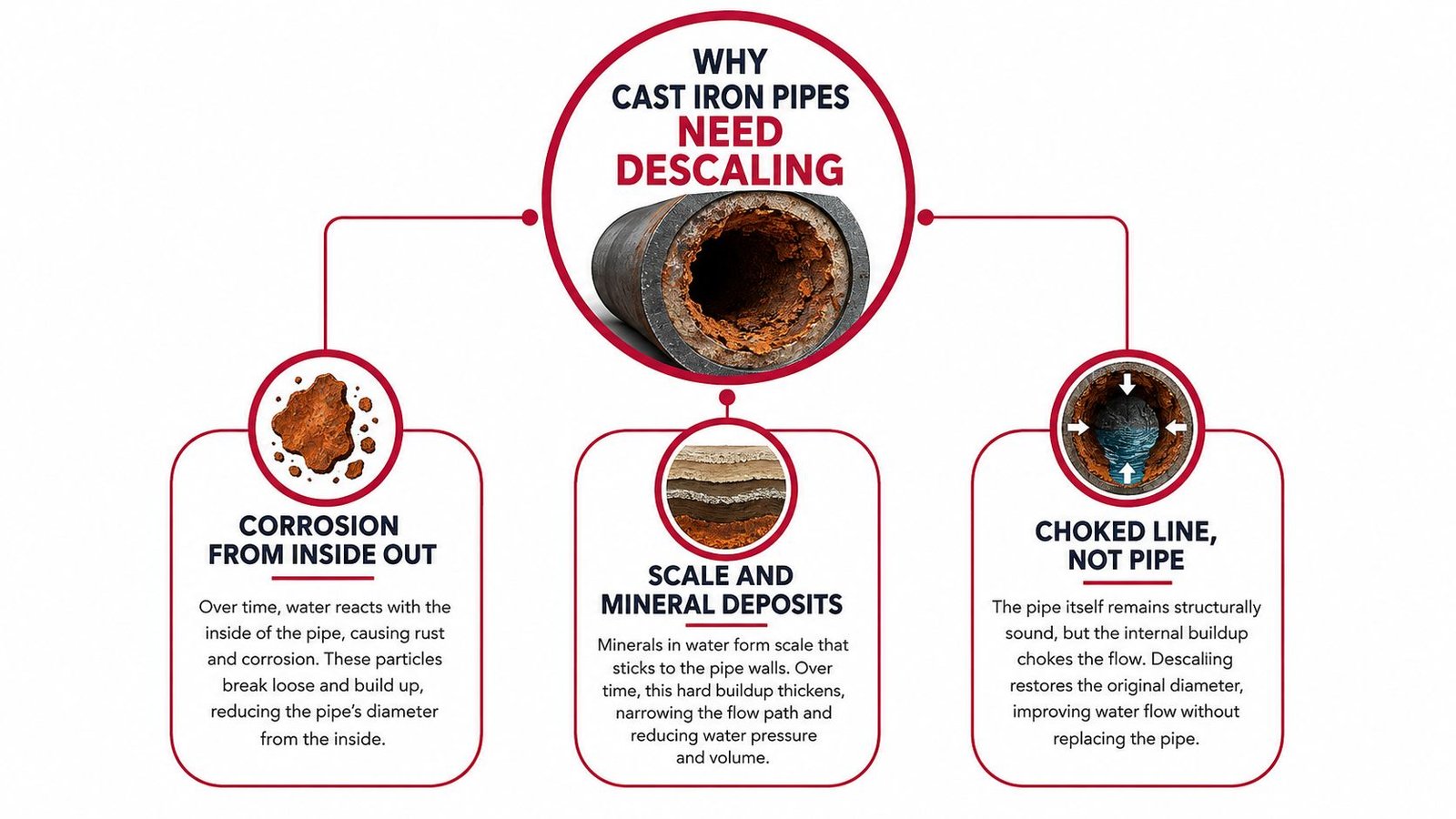
Corrosion does two things at once: it consumes metal and produces iron-bearing deposits inside the pipe. Those deposits can develop into tubercles, hard, irregular formations that narrow the passage and increase resistance to flow, as explained in Virginia Tech's technical review of iron-pipe corrosion. Removing that buildup addresses the restriction, but it doesn't replace the metal corrosion already consumed.
Read the restriction and the wall separately
On camera, tuberculation looks like an uneven crust projecting into the opening. Don't confuse that rough surface with proof that the underlying pipe remains strong. The camera operator must distinguish deposits from cracks, missing sections, and other evidence of deterioration.
This diagram illustrates the buildup side of the problem, not a guarantee that every scaled pipe remains structurally sound.
Treat slow drains, gurgling, sewage odors, and recurring backups as reasons to investigate, not as a diagnosis. A broader review of household drainage problems can help you describe which fixtures are affected before the plumber arrives.
Practical rule: Pay for an explanation of what's restricting the line and what condition the pipe is in. Don't settle for “old cast iron” as the diagnosis.
My recommendation is straightforward: authorize descaling when the contractor can explain why the deposits are removable and why the remaining pipe can tolerate the proposed method. Don't authorize aggressive cleaning merely because the drain has backed up again.
Inspect Before You Clean
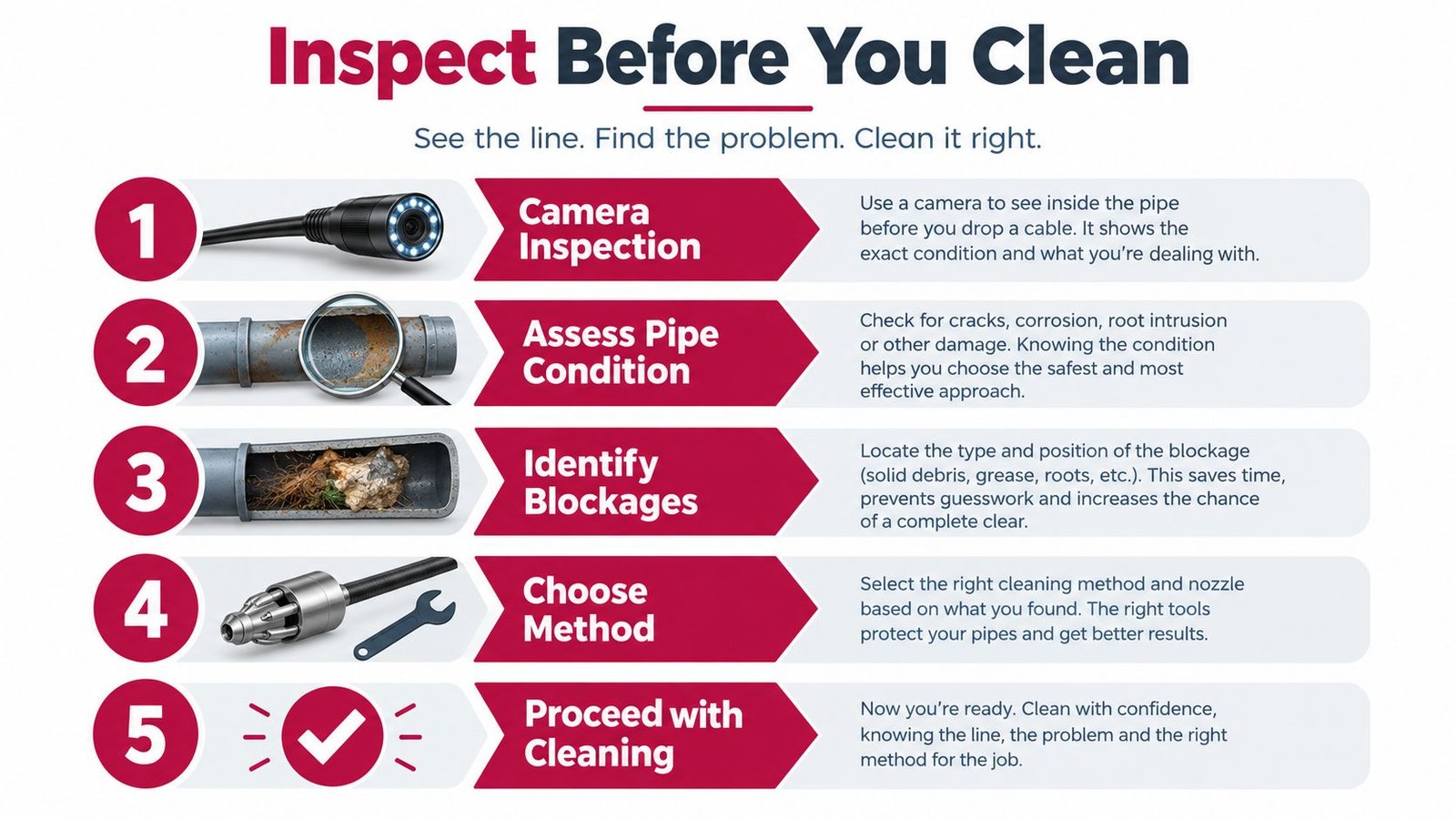
Never run a powered cleaning head into a line nobody has scoped. On cast iron, the camera survey is the job. Descaling is what the survey either justifies or rules out. Locate a usable cleanout, establish controlled access, and inspect before choosing equipment. If access requires installing a cleanout, put that work in the licensed plumber's scope rather than improvising an opening.
The cast-iron descaling field workflow calls for isolation, cleanout access, pre-cleaning CCTV, and documentation of conditions that can change the cleaning decision. Treat that recording as the deliverable, not a formality on the way to the machine.
What the survey has to show
Ask the operator to document:
- Pipe material and route: Which runs are cast iron, where they transition to other materials, and where access points sit.
- Obstruction type: Soft debris and grease versus hardened scale, because they call for different tools.
- Wall condition: Visible wall loss, channel rot along the bottom, perforations, and soil showing through.
- Joints and geometry: Cracks, offsets, displaced connections, bellies, and stormwater tie-ins that no amount of cleaning will fix.
A camera delivers visual evidence, and heavy deposits can hide the surface underneath. Require the contractor to state plainly what is visible, what remains uncertain, and whether a limited pass is needed just to get the camera through.
Stop conditions decided in advance
Ask what finding ends the job. A crack, a missing pipe bottom, or a displaced joint should close the cleaning conversation and open a lining or replacement one. If the camera cannot advance past the deposits, approve a limited pass to restore visibility, then reassess before anyone touches the rest of the line.
A professional plumbing inspection should connect the findings to a recommendation you can act on. Have the plumber name the exact section they propose to clean and explain why that method suits its documented condition.
Put post-cleaning video in the original scope. Removing scale strips away the material hiding the wall, and without a second recording nobody documents what is left.
DIY Methods That Actually Work on Cast Iron
Homeowner-level drain clearing and cast-iron descaling aren't the same job. A hand auger may address an accessible soft obstruction, but hardened wall deposits call for a different tool and a different level of control.
Keep DIY work narrow. If the documented problem involves a main, a stack, uncertain pipe condition, or a powered wall-contact tool, hire a trained contractor. Don't use rental-equipment availability as evidence that the job is appropriate for a homeowner.
DIY Cast Iron Descaling Methods at a Glance
| Method | Best For | Avoid If |
|---|---|---|
| Hand auger | An accessible soft blockage in a line already assessed as serviceable | The obstruction is hard wall scale or the cable meets unexplained resistance |
| Small drum machine | Limited cable clearing by someone trained to operate the equipment | The pipe condition is unknown or the job requires scraping the wall |
| Enzymatic cleaner | A product-specific maintenance option to discuss after diagnosis, not a descaling substitute | You expect it to remove hardened rust tubercles or resolve a backup |
| Vinegar or citric acid | Limited mineral-deposit softening only after compatibility is confirmed | The pipe is deteriorated, other chemicals are present, or the blockage chemistry is unknown |
| Chain knocker | Professional removal of hard scale from inspected, structurally suitable pipe | The wall has holes, severe deterioration, cracks, or displaced joints |
The table's dividing line matters: clearing soft material isn't the same as removing corrosion scale. Don't keep feeding a standard cable because it hasn't scraped the pipe clean. That's not what an ordinary drain auger reliably accomplishes.
Skip improvised chemical descaling
Don't pour concentrated hydrochloric or sulfuric acid into an aging cast-iron drain. The inspection workflow discussed earlier warns that those acids can attack old iron and create hazardous reactions. Mild acids aren't a universal workaround, either.
Chemical compatibility requires more than reading that a product removes minerals. An EPA technical report on detergent solutions and cast-iron soil pipe found corrosion under tested chemical exposures, which is a good reason to verify the actual formulation, concentration, contact time, and disposal requirements.
Don't use the pipe as a test container for a chemical you haven't verified.
Tell the plumber about anything already poured into the drain before they open the cleanout or begin work. My recommendation is to stop experimenting once the diagnosis points to hardened scale. Spend the next dollar on assessment, not another bottle.
Mechanical Descaling with Chain Knockers and Flexible Shafts
The chain knocker earns its place only after the camera says so. If the CCTV run showed hard tuberculation on a sound wall, a rotating chain on a flexible shaft will break that scale through controlled contact. If it showed holes, cracking, or a displaced joint, spinning carbide inside that pipe is how a cleaning job turns into an excavation.
This image shows the type of specialized equipment involved, not an ordinary homeowner drain cable.
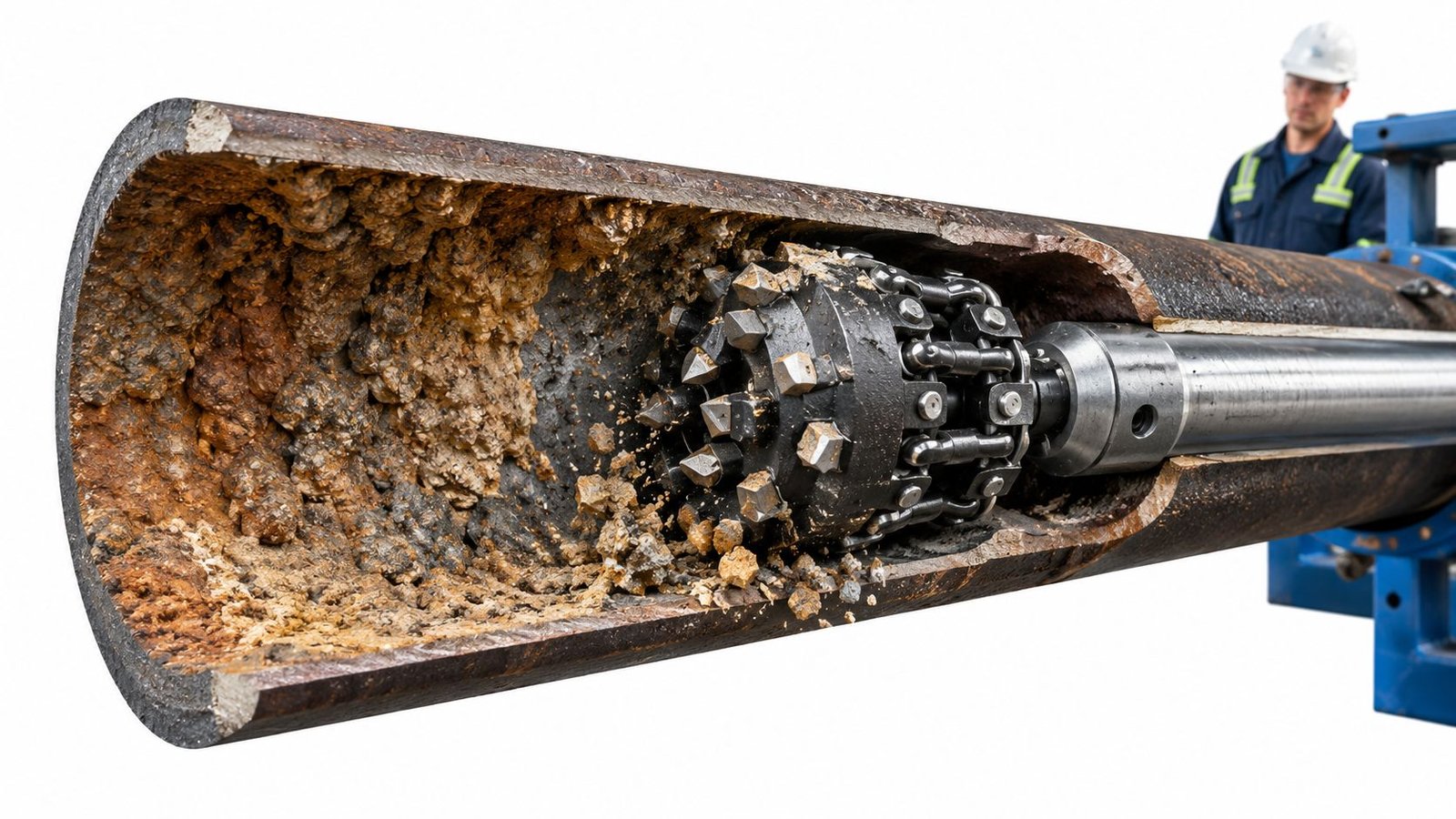
The AnvilField guide to drain cleaning, jetting, and snaking separates mechanical scale removal from basic passage clearing and limits the method to structurally suitable pipe. A carbide-tipped head or comparable flexible-shaft attachment may be the right call, and “more aggressive” still isn't automatically “better.”
Start undersized and keep the speed controlled
As noted earlier, the field workflow for this work recommends a conservative first-pass radius of roughly 1⅜ inches rather than 1½ inches in 3-inch pipe, run at lower rotational speed.
That figure describes a working radius rather than a chain size pulled off a shelf. The operator has to match the attachment, shaft, and equipment instructions to the measured diameter and the corrosion pattern the camera recorded. A nominal pipe diameter on an estimate is not permission to demand full-wall contact on the first pass.
There is no defensible universal speed setting for old cast iron. Ask the contractor how they will control rotation, limit contact, and react when resistance changes suddenly. Clear accessible soft debris first so the tool spends its time on the deposits it was selected to remove.
For comparison, how a drain snake clears a blockage shows why an open passage after snaking tells you nothing about wall condition.
The following video can help you discuss equipment and technique with the contractor.
Judge the pass by control, not appearance
- Limit the first pass: Establish how the deposits respond without immediately chasing bare iron.
- Reassess resistance changes: Stop and inspect rather than forcing the head through an uncertain section.
- Plan debris transport: Coordinate controlled flushing with the material being detached.
I'd rather see a conservative, documented result than a polished-looking bore achieved by repeatedly hammering a questionable wall. The objective is a usable passage without sacrificing serviceable pipe.
Hydro-Jetting Pressure, Flow, and Nozzle Selection
A free-flowing drain isn't proof of a healthy pipe, and maximum pressure isn't a cleaning plan. Hydro-jetting requires the contractor to balance deposit removal, debris transport, and the pipe's ability to withstand the work.
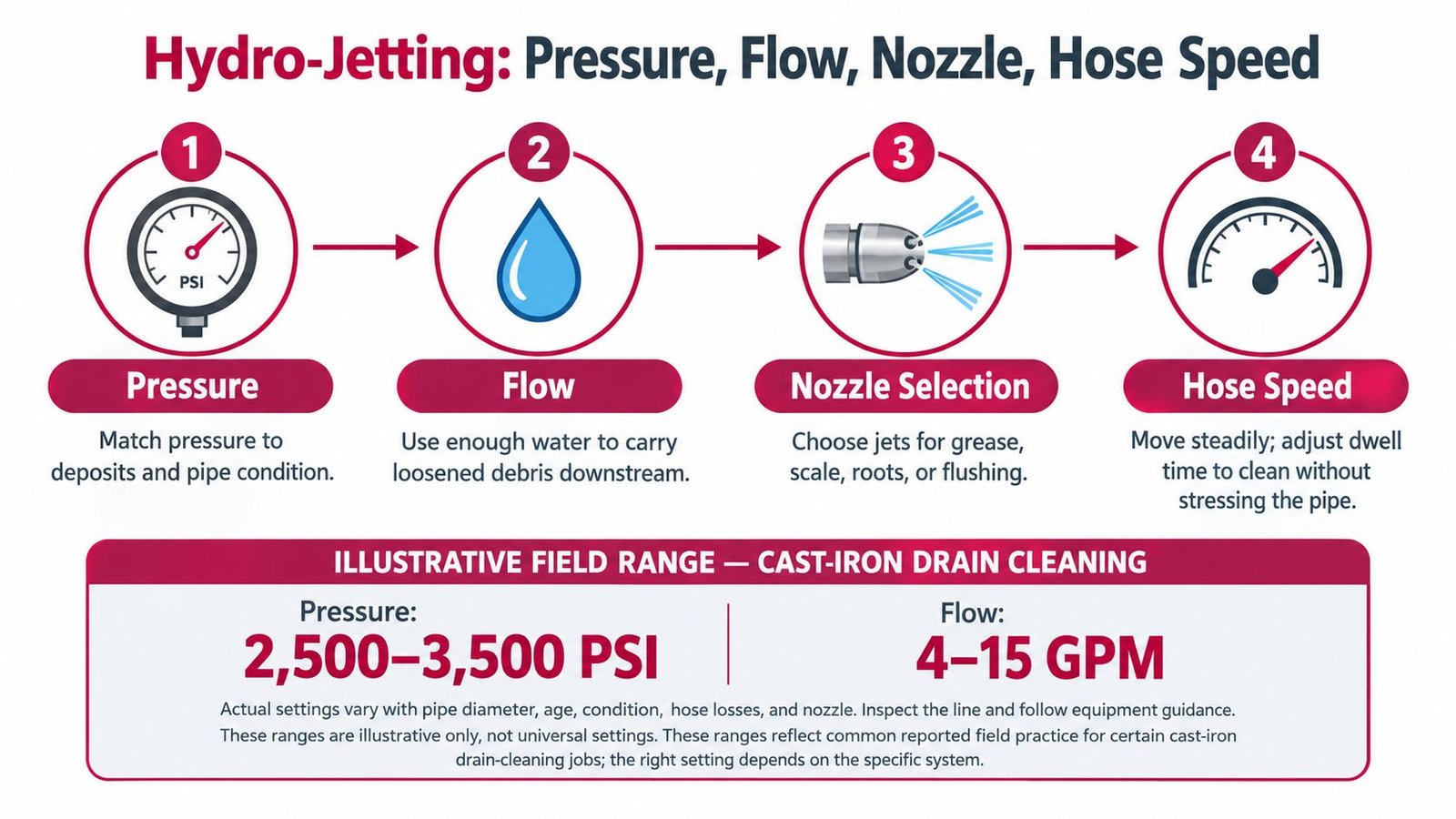
Published high-rise descaling and hydro-jetting field guidance gives operating examples of 3,000–3,500 psi at 8–12 gpm for hard tuberculation with forward-scouring or spinning-chain attachments, and approximately 2,000 psi at 18–25 gpm where carrying loosened scale, fats, oils, and grease is the main objective. That same guidance gives a hose-descent benchmark of no more than 1 foot per second.
Those are operating examples, not settings to copy onto an unknown residential line. The difference between deposit-cutting work and debris-transport work explains why a contractor shouldn't quote pressure alone.
Ask what each setting accomplishes
| Factor | What the contractor should explain |
|---|---|
| Pressure | Why the selected pressure suits the deposit and remaining pipe condition |
| Flow | How the water volume will transport loosened material |
| Nozzle | How the attachment will clean the intended surface rather than scour locally |
| Hose movement | How controlled travel will limit surges and maintain predictable cleaning |
This diagram shows the factors that belong in the equipment discussion.
Reject pressure-only promises
A nozzle that attacks a narrow area may leave deposits elsewhere. Adequate cutting pressure also won't solve the job if detached material settles downstream. Ask where debris will go, where it can be captured, and how the receiving section will be checked.
ASTM F3618-22 on pressure-water sewer cleaning treats this work as an operation requiring trained personnel, suitable equipment, and defined procedures. That's the standard of preparation you should expect, not a promise that the machine is powerful enough to handle anything.
Skip jetting where assessment identifies a structurally compromised wall. Don't accept mechanical cleaning as an automatic fallback, either. The contractor must justify that alternative against the same condition findings.
Equipment check: A useful proposal names pressure, flow, nozzle, and debris handling. “We'll blast it clean” doesn't explain any of them.
Risks Specific to Old Cast Iron
Old cast iron deserves scrutiny, not an automatic replacement verdict. Reports of municipal cast-iron mains remaining in service beyond 100 years, including some beyond 150 years, demonstrate that longevity varies, but those figures aren't a service-life promise for a residential drain, as discussed in WaterWorld's review of aging municipal pipe.
The decision should turn on condition. A pipe's calendar age tells you far less about today's cleaning risk than a visible defect in the section the tool is about to contact.
Recognize the findings that stop cleaning
Require the operator to pause and reassess when the work reveals:
- Large flakes: Inspect the newly exposed surface rather than assuming every fragment represents harmless scale.
- Sudden resistance changes: Investigate what changed before advancing the tool.
- Visible soil or perforations: Treat the finding as a structural problem, not an unfinished cleaning task.
- Cracks or an irregular wall: Determine whether further contact is justified.
- Severe channel deterioration: Discuss repair options instead of chasing a cleaner-looking opening.
These findings don't all mean the same repair. They do mean that continuing automatically is the wrong response. Ask the contractor to save the relevant footage and explain the consequence for the proposed scope.
A broader assessment of old plumbing pipe condition is useful when the issue extends beyond the section being cleaned. Don't let a successful local clearing postpone evaluation of clearly documented damage elsewhere.
Don't treat lining as an automatic cure
Cleaning cannot restore missing iron, but lining also requires a defensible design and assessment. The PHMSA research project on aging cast-iron pipeline rehabilitation identifies unresolved issues involving liner load transfer, long-term integrity, permeability, repair, and inspection.
That research concerns pipeline rehabilitation, not approval of a particular residential lining proposal. Its practical lesson is to ask how the proposed system addresses the documented defects rather than accepting “trenchless” as a complete explanation.
A successful-looking opening can be a warning if cleaning exposes a wall that shouldn't remain in service without repair. Stop evaluating the job by drainage alone.
Preparation, Cleanup, and Verifying the Job
A credible descaling proposal includes preparation and cleanup in the quoted scope. Require the contractor to isolate the affected line, coordinate fixture use, protect the work area, control wastewater, and select appropriate splash, eye, and hand protection.
Where high-flow equipment can displace air in building drains, the crew should establish open or monitored relief points as appropriate. Debris handling needs a destination, not an assumption that everything will disappear downstream.
Make the result verifiable
Ask for a completion record containing:
- Before-and-after footage: Show comparable sections and identify anything the camera couldn't assess.
- Equipment details: Record chain size, nozzle, operating pressure, and flow where applicable.
- Defect documentation: Identify newly exposed damage, its location, and any measurements obtained.
- Access confirmation: Verify that service connections and cleanouts remain accessible.
- Written disposition: State whether the recommendation is maintenance, localized repair, lining, or replacement.
Keep that record for future maintenance and capital planning, particularly at commercial properties where repeated disruption affects operations.
Compare scope before price
Choose cleaning for suitable pipe with removable restriction. Request localized repair for a discrete defect, and evaluate rehabilitation or replacement when deterioration extends beyond what cleaning can address.
Don't rely on a generic ballpark price without pipe length, access, condition, and restoration scope. Request separate written estimates for applicable options, plus warranty terms covering workmanship, exclusions, recurring blockages, and responsibility for newly exposed defects. A drain-cleaning warranty isn't a structural guarantee.
Call a licensed plumber for visible cracks, recurring backups despite cleaning, indoor sewage odors, or work involving a stack or main. You can contact a local licensed drain specialist directly or use WhatsDemand to coordinate with a vetted, licensed professional. Request CCTV assessment, a condition-based cleaning or repair recommendation, and post-work verification before authorizing aggressive descaling.