

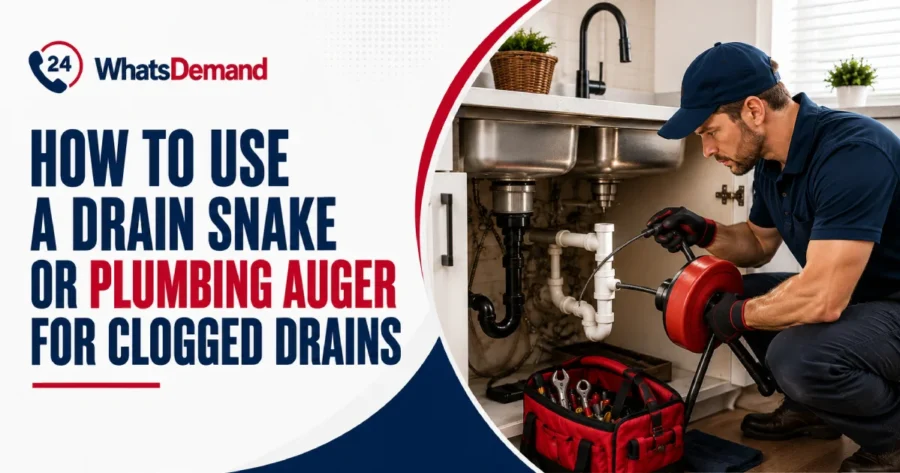
To use a drain snake or plumbing auger for clogged drains, residents in the USA must prepare the area, feed the cable, break up the clog, and test the drain. A sewer snake is a flexible cable tool designed to reach and clear blockages inside drain lines.
Proper use of an auger or drain snake prevents cable kinking, pipe damage, and incomplete clog removal, while the steps help improve effectiveness through controlled pressure and rotation. WhatsDemand explains when professional drain cleaning services are more effective, for recurring or severe blockages.
Can’t Clear the Clog With a Drain Snake?
Our professional plumbers can safely locate and clear stubborn, recurring, or deep drain
blockages before they cause bigger plumbing problems.
1. Prepare the Area
Prepare the area before inserting a drain snake to protect surrounding surfaces and prevent cross-contamination from drain backflow. Lay drop cloths or old towels beneath the P-trap and cabinet base to catch wastewater and debris.
Keep a bucket, rubber gloves, and safety goggles within arm’s reach. Chemical drain cleaner residue in standing water creates a splash hazard. Clear out items stored under the sink to give full access to the drain line and shutoff valves.
2. Prepare the Drain
Prepare the drain by removing the stopper, strainer, or drain cover to get direct access to the drain line opening. Use a screwdriver to detach the stopper linkage on bathroom sinks, or unscrew the strainer basket on kitchen drains.
Skip any chemical cleaners at this stage. Mixing caustic solutions with auger cable work increases splashback risk. The cable insertion process can begin cleanly, with the drain opening exposed and the work area secured.
3. Feed the Cable into the Drain
Feed the cable into the drain through the exposed drain opening (not the overflow plate) once the stopper or strainer is fully removed. Extend 6 to 8 inches of coiled cable from the drum housing, tighten the setscrew, then hand-crank the drum handle clockwise to advance the cable forward.
Keep the drum close to the drain opening to reduce cable slack and prevent kinking. Loosen the setscrew, pull out another 6 to 8 inches of cable, retighten, and repeat until the cable moves deeper into the drainpipe.
4. Navigate Curves & Reach the Clog
Navigate curves and reach the clog as the advancing auger cable encounters the P-trap and lateral pipe bends inside the drain system. Apply steady, rotational pressure on the drum handle to guide the corkscrew tip through the trap’s curvature without buckling the cable.
Forcing the cable too aggressively at bends causes the cable to fold back on itself, a condition called “birdcaging”, which damages the wire and restricts movement. Reduce feed speed at tight elbows and let the rotating tip steer through each directional change in the pipe.
5. Break Up or Catch the Clog
Break up or catch the clog once the rotating tip finishes navigating the pipe bends and resistance in the cable signals the stoppage location. Rotate the drum handle clockwise to let the helix tip bore into and latch onto the obstruction for organic blockages like hair accumulation or grease buildup.
The auger head snags the item and holds it for extraction. Push and pull the cable in short strokes while maintaining clockwise rotation to fragment dense clogs or fully entangle softer debris.
6. Retract the Cable
Retract the cable by reversing the drum rotation slowly while maintaining slight inward tension to keep the snagged clog or broken debris attached to the auger tip. Pull the cable out in controlled 6-to-8-inch increments, re-spooling it back into the drum housing as it exits the drainpipe.
Wipe the cable with a rag after each retracted segment to remove debris, grease, and biofilm before the next section feeds back through the drum. Dump the extracted clog material directly into the bucket (not the drain) to prevent re-clogging the line.
7. Test and Flush the Drain
Test and flush the drain after full cable retrieval to confirm the blockage cleared and flow restored through the drain line. Run hot water at full pressure for 2 to 3 minutes and observe the drainage rate at the fixture.
Reinsert the auger cable and repeat the snaking process. The residual debris or a secondary blockage down the pipe is common if water backs up again. A consistent drain flow with no pooling confirms the drainpipe is clear.
What Types of Drain Snakes Are Available and Which Should You Choose?
The types of drain snakes available and which one you should choose are listed below.
- Manual Drain Snake: A hand-cranked, coiled steel cable tool running 15 to 25 feet long that clears hair clumps and soap scum in bathroom sinks and shower drains.
- Handheld Drain Auger: A compact, pistol-grip or T-bar drum tool that targets medium-depth clogs in bathroom and utility sink drains without floor-mounted equipment.
- Drum Auger: A canister-style unit with 25 to 75 feet of 1/4 to 3/8-inch cable that drives consistent torque through P-traps, lateral bends, and deep fixture blockages.
- Electric Drain Auger: A corded 120V or cordless motorized power snake with auto-feed cable up to 120 feet long that clears main sewer lines, tree root intrusions, and deep grease blockages. An electric drain auger with a ⅜-inch cutter head clears grease buildup that a manual drain snake does not penetrate for a clogged sink drain in a kitchen line.
How Do You Choose the Right Cable Length and Size for Your Clog?
Choose the right cable length and size for your clog by matching the plumbing snake’s cable diameter to the pipe size and the cable length to the fixture depth. A 1/4-inch cable handles 1-1/4 to 1-1/2-inch sink and tub lines with a 25-foot run.
A 3/8-inch cable covers 2- to 3-inch shower and floor drain lines at 25 to 75 feet. Bathroom sinks and tubs clear with a 25-foot, 1/4-inch cable, while kitchen lines and sewer laterals need a 3/8- to 3/4-inch cable at 50 to 100 feet.
Drain Snake vs. Plunger vs. Chemical Cleaners: Which Is Better?
A drain snake is better than a plunger and chemical cleaners. By clog type, a plunger handles only soft, shallow blockages near the drain opening, while a drain cleaner snake reaches compacted grease and deep hair tangles past the P-trap. On severity, chemical cleaners partially dissolve dense blockages and push residual sludge deeper into the lateral line.
For safety, caustic agents (sodium hydroxide) corrode cast iron and galvanized steel pipe walls over repeated use. In terms of effectiveness, a drain cleaner snake extracts the obstruction through direct cable-to-clog contact, with no chemical residue and no pipe degradation. The f guide covers product-specific differences in all three methods for homeowners dealing with recurring blockages.
How Do You Know When the Drain Snake Has Reached the Clog?
The drain snake has reached the clog when the cable suddenly slows or stops, the drum handle becomes harder to turn, and firm resistance replaces the smooth friction of normal pipe bends.
Soft clogs (hair feels like a mushy drag), while hardened grease or solid objects create a more definite stop. The plumber must use short push-pull movements with steady clockwise rotation to work the cable into the blockage without forcing it.
How Can You Clear a Drain Without Damaging PVC or Older Pipes?
Clear a drain without damaging PVC or older pipes by using controlled pressure and steady clockwise rotation rather than forcing the cable through resistance.
Reduce pressure at tight bends and fragile fittings, as excessive force can crack PVC or damage weakened connections. Use a smaller cable and slower feed speed for aging systems, and inspect old plumbing pipes before snaking to avoid worsening existing damage.
How Do You Clean, Sanitize, and Store a Drain Snake?
Clean, sanitize, and store a drain snake by removing trapped debris, wiping the cable, and disinfecting it after each use. Dry the cable completely to prevent corrosion, rust, and unpleasant odors, then apply a light coat of lubricant.
Store the drain snake in a dry, ventilated area to protect the cable and extend its service life.
What Should You Do If the Drain Snake Gets Stuck?
To free a stuck drain snake, follow the five steps listed below.
- Stop Advancing the Cable. Stop feeding the cable when it meets firm resistance to prevent kinking, birdcaging, or damage to the drainpipe.
- Rotate the Cable Slowly. Turn the drum handle in controlled movements to release the auger head from the blockage without forcing it.
- Retract the Cable Carefully. Pull the cable back gradually while maintaining slight rotation, following the same principles used in how to work a drain snake safely.
- Inspect the Auger Head. Check the retrieved cable for trapped debris, bent sections, or damage before attempting to clear the drain again.
- Contact a Licensed Plumber. Seek assistance when the cable remains stuck, repeatedly catches on the pipe, or cannot be retracted without excessive force.
What to Do if Snaking the Drain Doesn’t Clear the Blockage?
To troubleshoot a drain that remains blocked after snaking, follow the five steps listed below.
- Check the Cable Depth. Check whether the snake reached far enough into the drain, as reaching only part of the blockage may leave debris behind.
- Inspect the Retrieved Cable. Examine the cable for hair, grease, or other debris to determine whether it contacted the blockage.
- Use a Suitable Snake. Select a cable with the correct diameter, length, and head type for the pipe size and clog location.
- Repeat the Snaking Process. Reinsert the cable and work through the blockage again using controlled rotation and short push-pull movements.
- Flush and Recheck the Drain. Run water through the fixture to confirm improved flow and determine if another blockage remains farther inside the drain system.
What Are the Signs of a Main Sewer Line Clog vs. a Local Fixture Clog?
The signs of a main sewer line clog and a local fixture clog are listed below.
- Multiple Slow Drains: Fixtures drain slowly at the same time, indicating a possible main sewer line obstruction.
- Single Fixture Backup: One sink, tub, or toilet backs up while other fixtures drain normally, indicating a localized clog.
- Sewage Backup: Wastewater backs up through floor drains or lower-level fixtures, indicating a severe main line blockage.
- Gurgling Toilets: Toilets gurgle when nearby fixtures discharge water, indicating restricted flow in the main drain line.
- Localized Water Pooling: Water remains around one fixture after use, indicating an obstruction near that fixture.
- Recurring Drain Backups: Multiple fixtures repeatedly back up after temporary clearing, indicating a deeper blockage in the main sewer line.
When Should You Stop DIY Attempts and Call a Licensed Plumber?
You should stop DIY attempts and call a licensed plumber when the drain remains blocked after repeated snaking, the cable becomes stuck, or multiple fixtures back up simultaneously.
Proper drain snake techniques help prevent pipe damage, but persistent clogs require equipment and inspection. Residents must call for professional plumber assistance when the blockage involves a main sewer line, damaged piping, or an obstruction that cannot be safely reached with a standard snake.
Should You Run Water While Using a Drain Snake?
No, you should not run water while using a drain snake. Standing water creates a splash hazard and makes it harder to control the cable as it enters the drain.
Water must be run only after the cable is removed to test if the blockage has cleared. It helps confirm that the drain is flowing normally without causing a mess in snaking.
Is a Clog Worse After Snaking the Drain?
Yes, a clog can worsen after snaking the drain. Improper snaking can push debris farther into the drain line or leave part of the blockage behind.
Repeated backups, slow drainage, or gurgling after snaking indicate that the clog was not fully cleared. Excessive force can damage the cable or drainpipe when the blockage does not release.
Does Dawn Really Unclog Drains?
Yes, Dawn really unclogs drains. The Dawn degreasing action can break down greasy residue and improve water flow through minor blockages, but it is not a reliable solution for hair, solid objects, or deep clogs that require clearing.
A drain snake remains more effective when the blockage is compacted or located deeper in the drain line.