

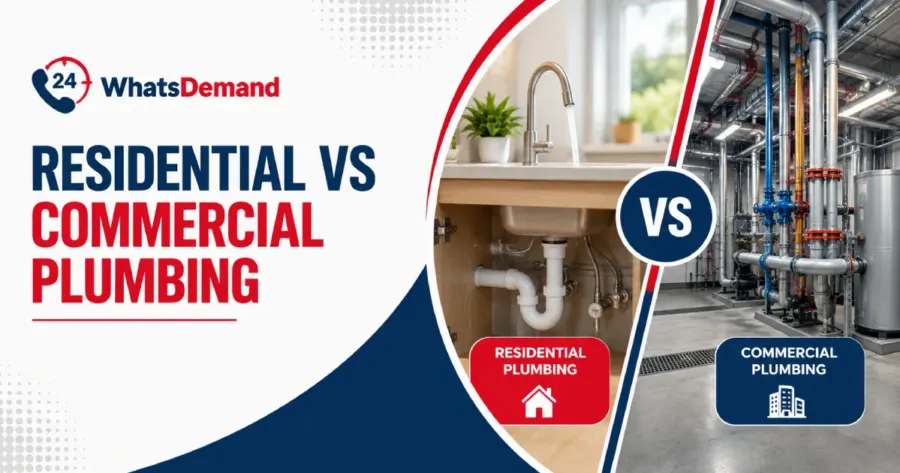
Residential vs. commercial plumbing is a comparison of two systems used for different types, water demands, and operational requirements. Residential setups run on gravity-fed toilets, 1/2-inch supply lines, and tank-type water heaters sized for a family of four, while grease interceptors, backflow preventers, and flushometer valves are used commercially.
Commercial systems add the missing components with booster pumps, medical-gas piping, and stamped engineering drawings, elements a single-family property rarely needs. Matching the right plumbing services to the actual demand keeps water flowing safely and code compliance intact, whatever the scale.
What Is Residential Plumbing?
Residential plumbing is a line of potable water supply, Drain-Waste-Vent (DWV) piping, and fixtures installed inside single-family homes and townhouses under IRC Chapter 29 and Chapter 26 standards. Residential moves clean water to sinks, tubs, and toilets while carrying wastewater and sewer gases away from the structure through vented drain lines and traps.
Fixture-unit ratings, backflow prevention devices, and NSF 61-certified materials determine pipe sizing, water pressure, and code compliance for each installation, ensuring safe potable delivery from residential.
What Is Commercial Plumbing?
Commercial plumbing is a large-scale water distribution for office buildings, restaurants, hospitals, and multi-story structures under the International Building Code (IBC)Chapter 29 standards. The commercial handles higher occupancy loads through wider-diameter piping, grease interceptors, medical gas lines, and backflow preventers that protect the public potable supply from contamination.
ADA-compliant fixture heights, mandatory inspection schedules, and stricter permit classifications separate commercial installations from residential systems governed by the International Residential Code (IRC) for buildings exceeding three stories or serving food-preparation occupancies.
What Is the Difference Between Residential and Commercial Plumbing?
Residential is a low-demand system, while commercial is a high-demand network for huge establishments and occupants. The Drainage Fixture Unit (DFU) accumulation tables size commercial piping far beyond home dimensions, since peak calculations must sustain 8 PSI pressure at the remote fixture.
Residential plumbing systems and single-family homes do not maintain the same water pressure in buildings with more than four stories or over 100 occupants, where higher demand requires booster pumps. Systems follow the same principles for protecting drinking water and DWV systems, but differences in size, building code requirements, and water demand mean one system cannot be applied directly to the other.
What Types of Buildings Require Commercial Plumbing?
The types of buildings that require commercial plumbing are listed below.
- Restaurants and Food-Service Establishments. Restaurants rely on grease interceptors and high-capacity drainage lines to manage kitchen wastewater discharge under their IBC Group A-2 classification.
- Hospitals and Nursing Facilities. Hospitals install medical gas piping, backflow preventers, and fixture ratios suited to non-ambulatory patients.
- Multi-Family Apartment Complexes. Apartment complexes depend on shared risers and DWV stacks for peak-hour demand once a building holds more than two dwelling units.
- Hotels and Extended-Stay Lodging. Hotels operate centralized hot-water recirculation systems and backflow protection in guest bathrooms under the Group R-1 designation.
- Office Towers and Business Complexes. Office towers maintain steady water pressure on multiple floors through tiered fixture counts and booster pumps.
- Shopping Malls and Retail Stores. Malls install public restroom fixture ratios and floor drains sized for heavy pedestrian foot traffic typical of Group M establishments.
- Schools and Educational Institutions. Schools provide drinking fountain counts and fixture ratios calculated from IBC Table 2902.1 occupant loads under the Group E classification.
- Industrial and Manufacturing Plants. Manufacturing plants route process piping, chemical-resistant drainage, and industrial-grade backflow devices to handle production wastewater as Group F facilities.
- Warehouses and Distribution Centers. Warehouses connect service sinks and standpipe systems into the building’s fire-suppression water supply under the Group S designation.
- High-Rise Buildings. High-rise towers exceeding 75 feet use zoned pressure-reducing valves and redundant riser systems to serve their upper floors under IBC provisions.
What Types of Fixtures Are Used in Commercial vs Residential Plumbing?
The types of fixtures that are used in commercial vs. residential plumbing are listed below.
| Fixture Type | Residential Version | Commercial Version |
|---|---|---|
| Toilet | Gravity-fed tank toilet drawing water from a stored reservoir for each flush | Flushometer-valve toilet drawing water straight from a pressurized supply line |
| Urinal | Rarely installed in homes | Wall-mounted urinal with manual or sensor-activated flush valve |
| Faucet | Single-handle lavatory faucet built for low-frequency household use | Sensor-activated touchless faucet built for continuous public-restroom traffic |
| Floor Drain | Limited to basements or laundry rooms | Floor drain with trap primer installed throughout restrooms and kitchens |
| Grease Management | Absent from household kitchens | Grease interceptor required for food-service wastewater |
| Sink | Kitchen sink paired with a garbage disposal | Multi-station wash trough or service (mop) sink for staff use |
| Water Heater | Tank-type or tankless unit sized for one household | Commercial-grade water heater sized for simultaneous multi-fixture demand |
| Shower/Bath | Bathtub and shower combination unit | Sensor shower system or emergency eyewash and shower station |
| Outdoor Connection | Hose bib for yard or garden use | Standpipe connections tied into fire-suppression systems |
| Accessibility | Standard-height fixtures | ADA-compliant grab-bar fixtures and hi-lo drinking fountains |
Residential fixtures run on tank-based, low-pressure systems built for one household’s intermittent use, while commercial fixtures run on flushometer-valve systems built for high demand. That gap in pressure requirements and supply-line diameter keeps residential fixtures unsuitable for commercial spaces and commercial fixtures impractical for ordinary homes.
How Do Commercial and Residential Water Heaters Compare?
A commercial water heater is a high-capacity unit exceeding 100 gallons with British Thermal Unit (BTU) inputs reaching 199,000 to sustain hot-water demand in hotels and restaurants, while a residential heater is a smaller 30- to 80-gallon tank rated near 30,000 to 40,000 BTU for a single household’s use.
Units surpassing 120 gallons or 200,000 BTU require ASME-stamped tanks and mechanical rooms, which residential models never reach. Commercial tankless systems exceed 15 Gallons per Minute (GPM) through heat exchangers, while homes need only 3 to 6 GPM from a single unit. Choosing between the two water heaters comes down to occupant load. A household tank does not meet a hotel’s peak draw, and a commercial unit oversizes any single-family application.
How Do Commercial Toilets Differ From Residential Toilets?
Commercial toilets differ from residential toilets through their flushometer-valve mechanism, which draws water from a pressurized line at 25 PSI or higher, unlike the gravity-fed tank found in residential bowls running at 10 to 15 PSI. The commercial design needs a 1-inch supply line to handle continuous public-restroom traffic, while homes run on a 1/2-inch line paired with a standard 12-inch rough-in.
Vitreous china bowls in commercial places slope backward toward the wall for faster drainage, unlike residential bowls that slope forward into the room. ADA-compliant floor-mounted or wall-mounted models with concealed tanks dominate offices and restaurants, while two-piece or one-piece tank toilets remain standard in residential bathrooms.
How Do Commercial-Grade Faucets Compare to Residential Faucets?
Commercial-Grade faucets are touchless or heavy-duty fixtures certified under ASME A112.18.1/CSA B125.1 for public use, while the residential faucets are single-handle fixtures certified under NSF/ANSI 61 for household use.
Commercial units favor sensor-activated designs with moving parts and no pop-up drain, reducing bacteria buildup in restrooms serving daily users. Industrial-finished valve stems in commercial faucets withstand cycling, while residential faucets offer wider finish choices (polished chrome or antique bronze) for lower-frequency use.
What Plumbing Codes and Regulations Apply to Residential vs Commercial Plumbing?
The plumbing codes and regulations that apply to residential and commercial plumbing are the IRC for one- and two-family dwellings and the International Plumbing Code (IPC) paired with IBC Chapter 29 for commercial structures and multi-story buildings. EPA WaterSense standards cap residential toilets at 1.28 gallons per flush and lavatory faucets at 1.5 GPM, figures that the IPC Table 604.4 mirrors for public fixtures under the same 60 PSI test pressure.
Commercial spaces layer Americans with Disabilities Act (ADA) accessibility standards, grease-interceptor mandates under IPC Section 1003.3, and drawings onto the base plumbing code once occupant load or building height crosses local limits. Residential installations skip it, since local jurisdictions enforce IRC provisions through simpler permit and inspection processes suited to single-family homes.
How Do You Choose Between a Residential and Commercial Plumbing Contractor?
Choosing between a residential and commercial plumbing contractor starts with verifying license classification. States like Arizona separate C-37 commercial credentials from C-37R residential ones, while a dual CR-37 license covers scopes. A contractor bidding on a restaurant or hospital needs proven grease-interceptor, backflow-prevention, and stamped-engineering-drawing expertise absent from single-family plumbing work.
Confirming active general liability insurance, workers’ compensation coverage, and a scope of work matching the building’s occupancy classification protects the owner from compliance failures down the line.
Is the Industrial Plumbing System More Complex than Residential and Commercial?
Yes, an industrial plumbing system is more complex than residential and commercial systems. It follows ASME B31.3 process piping standards, which govern hazardous fluid categories, up to 100% non-destructive examination for Category M service, and corrosion-resistant materials found in refineries, chemical plants, and pharmaceutical facilities.
Can a Residential Plumber Work on Commercial Plumbing Systems?
No, a residential plumber cannot work on commercial plumbing systems without a higher license classification.
Georgia’s Master License Class 1 restricts holders to single-family homes and commercial structures under 10,000 square feet, while Master License Class 2 removes that cap entirely. A plumber needs the unrestricted Class 2 credential to legally take on hospitals, office towers, or other large-scale plumbing systems.
Why Is Commercial Plumbing More Expensive than Residential Plumbing?
Commercial plumbing more expensive than residential plumbing because a single building needs 20 to 50 fixtures against a home’s 2 to 4, demanding larger-diameter piping, industrial-grade materials, and specialized labor to handle that scale.
Booster pumps for upper-floor water pressure and multi-phase code inspections add requirements that single-family plumbing never carries.
Do Commercial Plumbing Systems Require More Maintenance?
Yes, commercial plumbing systems require more maintenance than residential setups. Grease-interceptor cleanouts, backflow-preventer testing, and fixture inspections in high-traffic restrooms demand a recurring maintenance checklist that homes never needed.
What Skills Does a Commercial Plumber Need?
The skills that a commercial plumber needs are blueprint and Building Information Modeling (BIM) reading to coordinate large-scale piping layouts, certifications in backflow prevention, medical-gas brazing, and welding to service high-occupancy fixture systems.
Strong knowledge of the International Plumbing Code (IPC), with the ability to test and commission hydro, air, and trace-gas systems, completes the skill set a commercial plumber requires.
Is Commercial Plumbing a Good Career Compared to Residential Plumbing?
Yes, commercial plumbing is a good career compared to residential plumbing. Expert plumbers with commercial specialty certifications (medical gas installation or backflow testing) earn $100,000 to $130,000 annually, well above the trade’s annual wage of $62,970.